Avoiding the Pitfalls of Halloween

With Halloween just around the corner, the time has come to navigate the minefield that is choosing a costume. Dressing up for Halloween can be fun, but it has, to some extent, morphed from being a scarefest into a hotbed for casual racism and sexism. Here are three issues surrounding Halloween costumes which bother me.

Dressing up as a racial stereotype

I’m actually astounded that some people think of these as legitimate Halloween costumes. White people dressing up as Asian geishas, African-American pimps, Arab terrorists, and so on, is rude and downright offensive. It shows a complete lack of understanding of the lived reality of the lives of non-white people, and an insensitivity to the way our lives are negatively affected by the very stereotypes being perpetuated for the sake of a few laughs. It contributes to the othering and marginalisation of racial minorities by portraying us as a separate species, to be parodied and summed up by one outfit, stripped of individual differences.

A group of students from Ohio University called “Students Teaching About Racism in Society” (STARS) have started a campaign against such costumes. Their posters are very powerful, and have gained lots of publicity:

(all pictures are from STARS)


How to avoid this: Easy – steer clear of racial costumes.

Men dressing up as ‘sexy’ or ‘ugly’ women for a joke

From Fancy Dress Ball – The Online Fancy Dress Shop

Sadly, this doesn’t happen only on Halloween. In the UK, a skirt, wig, high heels, fake boobs and make up is an oh-so-funny get-up for male university students, whenever a costume is required. The hilarity depends on the indignity that we perceive to be inherent in a man dressing as a woman, and the more sexualised the costume, the funnier it is supposed to be. Or they sometimes just turn to mocking women who don’t conform to patriarchal ideals of beauty; that works for them too:

From Halloween Spirit

I must be clear that I am not referring to trans women here, or men who like to cross-dress occasionally. I am talking about the outfits that you see in the pictures above, and others like them, that are clearly meant to be ridiculous, and to elicit guffaws from all their lad friends.

How to avoid this: If you’re a man genuinely wishing to dress up as a female character, (and make sure it is a female character, not just ‘Woman’,) do it in all seriousness, and spend the night urging others to critically analyze why they might find it funny. Otherwise, just stick to vampire/monster/skeleton.

The epidemic of sexy female costumes

Have a browse through some Halloween costumes online, or take a trip to your nearest costume shop. Then see how spot-on this cartoon is:

A man’s costume can be scary, funny, weird or disgusting, but God forbid a woman be anything but sexy! I’ve seen this framed as simply a Halloween issue, and indeed I’m writing about it in the context of Halloween costumes, but the problem extends much further than that. Moving away from the realm of costumes, we see this phenomenon in every aspect of our lives. It isn’t enough for a woman to be a world-class athlete, a comedian, a CEO, or a politician, she must never forget her duty to appear attractive at all times. This is why it makes sense for media outlets to report on the figure of Marissa Mayer, the CEO of Yahoo; for people to mock Olympic gold-medallist Leisel Jones for being ‘fat’; for hecklers to insult Hillary Clinton’s appearance. Last time I checked, physical attractiveness was not a competency required to be a successful athlete, CEO or Secretary of State. Unless, of course, you’re a woman in a patriarchy. Then it’s always required.

Solution: If, like me, you’re tired of the mandate to be constantly sexualised, focus on being scary or funny this Halloween. Non-sexualised costumes for women are few and far between, but they do exist, together with unisex costumes that are pretty ace. Or if you’re feeling creative, DIY is a great way to go.

————–
Happy Halloween!

Why We Cannot Eradicate Homophobia by Ignoring the Nick Griffins of the World

If you’re from the UK, you’ve probably heard about Nick Griffin’s infamous tweet by now, in which he publicised the address of a gay couple who had just won compensatory damages for being discriminated against at a B & B. The tweet(s) read, “So Messrs Black & Morgan, at [their address]. A British Justice team will come up to Huntington & give you a…” “…bit of drama by way of reminding you that an English couple’s home is their castle. Say No to heterophobia!”

For those not from the UK, Nick Griffin is the leader of the British National Party, a far-right political party famed for its extreme anti-immigration views, its denial of the holocaust, and its racist, sexist and homophobic ideology. They have advocated for the repeal of anti-discrimination legislation, would like to not only stop all immigration to the UK, but to reverse it, and have been known to drop bags full of excrement in the letterboxes of South Asian families.  Not content with being merely racist, the BNP have also displayed their sexism and homophobia. Some quotes from its members (some now ex-members) include, “Rape is simply sex,” “Some women are like gongs, they need to be struck regularly,” and references to gay people as “AIDS monkeys” and “bum bandits.”

A pleasant bunch then. Fortunately, they have little support from the majority of British people, and are generally spoken of with loathing. Following Nick Griffin’s tweets encouraging his supporters to harass the couple at their home, Twitter users were quick to condemn his actions, as well as his views in general. The media, too, wrote of him disapprovingly, and the public has rallied around the couple to express their support.

So far, so good. However, I am wary of the tendency to portray Griffin and his ilk as anomalies, as villains who have nothing to do with the rest of us ‘good folk’, and whose ideas and actions can be simply ignored. If we do so, then we avoid critical analysis of our society, and we ignore the underlying prejudices that enable such extreme ideas to germinate in the first place.

To illustrate, let’s examine the causes of homophobia. In my opinion, there are four main facets to this.

1. Religious beliefs. If people take the Bible, Qur’an, or other religious texts to be true, they come to believe that homosexuality is morally wrong. This translates into disapproval of both lesbians and gay men.

2. A sense of male entitlement to female bodies. This generally leads to the fetishising of lesbian activity for the male gaze and male pleasure, which can quickly turn into hate and anger when a lesbian denies them this ‘right’, or shows herself to be completely indifferent to male sexual approval.

3. Credit for point number 3 comes from an internet meme, which defined homophobia as “the fear that gay men will treat you the way you treat women.” This is applicable only to homophobia directed at gay men, and succinctly explains the fear and disgust that some straight men feel at the thought of being hit on by another man.

4. Rigid gender roles, combined with the valuing of the masculine over the feminine. Again, this last point is only applicable to gay men, who are frequently the brunt of ridicule, especially from straight men. When society operates with the conviction that traditionally masculine traits are superior to traditionally feminine ones, then men who choose to engage in activities that we associate with women – such as shopping, knitting, ballet-dancing, baking, playing with dolls, or in this case, having sex with men – are degrading themselves. By not conforming to usual ideas of what a manly man should be, they have let their fellow men down, and have forfeited their lad card.

Is Nick Griffin the only one to perpetuate homophobia? Are homophobic ideas confined to the BNP and their supporters? Of course not. I could give you a million examples of complicit homophobia taken from a dozen different sources. Or I could just turn to some of the tweets that, far from supporting his views, were actually angrily condemning Nick Griffin.

“Now then @nickgriffinmep you small penis lard bucket, fuck off you boring bastard, everybody hates you! #racistbastard”

“@nickgriffinmep you’re a fanny”

“@nickgriffinmep why do you continue to speak against homosexuality and against Islam… Be a man.”

“this man is so gay he’s the epitome of gay”

“he’s probably cross dressing secretly in his loft”

Now don’t get me wrong. I know that their heart is in the right place, and applaud their willingness to speak out against Griffin’s atrocious opinions. But I also find them interesting as a snapshot of societal norms, where slurs on a man’s masculinity (“small penis”, “be a man”) are insults that we hardly think twice about, and where the word ‘gay’ is still accepted as a way to poke fun at someone. Going back to the causes of homophobia I outlined above, these comments are symptoms of the fourth point, and inadvertently contribute to the very thing they wish to deride. It speaks volumes about the deep-rootedness of sexism and homophobia, that it even finds its way into the language of people who are in support of gay rights.

To truly abolish homophobia and other nastiness, it’s not enough to dismiss Nick Griffin and his kind as pariahs, while remaining complicit in the culture that continues to churn such people out. Rather, we should take it as an opportunity to examine why they think the way they do, and why they have enough of a following to form a legitimate political party. We can kick Nick Griffin out of the political landscape, but if we don’t take steps to revolutionise society itself, then we can be sure that someone else will soon pop up to take his place.

International Day of the Girl

The 11th of October is International Day of the Girl. Today, we raise our voices in support of girls worldwide, and pledge to double our efforts to invest in their future. Not only will today go down in history as being the first ever Day of the Girl, it is also made especially poignant by the case of Malala Yousafzai, who lies unconscious in hospital, having been shot in the head by the Taliban for speaking out about the importance of girls’ education.

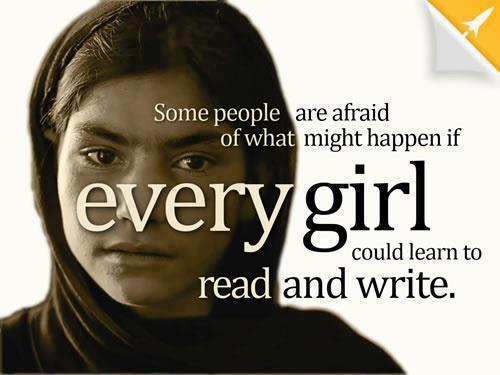
Reading about the tragedy two days ago, I kept thinking of a picture I had seen a while ago, and I decided to look for it again:


And that’s what the Taliban’s actions have revealed in the end – fear. Because Malala is not just any 14-year-old girl. By publicly condemning the actions of the Taliban and advocating for the education of girls, she represents an idea, a spark towards real social change. And by making an attempt on her life, the Taliban have revealed that they, too, know just how powerful she is.

On this day, then, let her be an inspiration to us all, and while she is silent, let us be her voice, and multiply her message a million times over. Let us express outrage at how 140 million girls and women have undergone female genital mutilation. How every year, about 10 million girls are married before the age of 18. How women in South Africa are more likely to be raped than to learn to read. How at least one out of every three women worldwide has been abused in her lifetime by someone known to her.

But outrage is not enough. We need to join the fight alongside women and girls everywhere, and there is no better weapon against all this than the education of girls. Please watch this incredibly moving video from It Only Takes a Girl:


To take action for girls, please visit the links below:

Because I am a Girl – Plan UK

The Girl Effect

Campaign for Girls

UNICEF – Girls’ Education Campaigns

Girl Up

The Working Group on Girls

The Elders

Most importantly, let’s not let the cause be confined to one day in a year. Every day and every girl matters in the struggle for full gender equality.

The Kissing Sailor, Part 2 – Debunking Misconceptions

Since writing this post about The Kissing Sailor, its reach has completely exceeded all my expectations, and has generated more discussion on my blog than ever before. As I read the comments though, I come across a couple of misunderstandings, and though many excellent people have responded with clarification, I see the same misconceptions popping up again and again.

So I thought I’d clear up some confusion once and for all. Here are some of the most common misconceptions.

Misconception #1: That kiss happened in a different time! How can you judge him using modern values?

The purpose of my original post was not to demonize George or to recommend that he be packed off to prison. A user on Reddit called MBlume gave a succinct response to someone who had Misconception #1. I’ll post it here:

“You’re…completely missing the point. The point isn’t that it happened. The point is that there’s three modern articles discussing the picture, all of which basically quote the woman in the picture as stating that it was sexual assault, and in none of the articles does the editorial voice acknowledge that that’s fucked up.”

This is spot on. Thanks, MBlume.

Misconception #2: Greta herself doesn’t call it a violation and actually seems alright with it. So your argument is invalid.

Indeed, in an interview given to Patricia Redmond, Greta does not seem traumatised by the kiss, and describes the fame that resulted from the photo in a positive manner.

However, I do think it’s worth taking into account that, even in today’s society, there is a lot of pressure on women to smile and get along, to ‘let boys be boys,’ to accept unwanted sexual contact like groping or kissing, and not to make a big deal out of it. Many of the comments have confirmed this, with gems like, “It’s just a kiss, get over it,” and how women should “stop whining” about such matters. In Greta’s case, the pressure would undoubtedly be much higher.

But one thing Greta consistently asserts is that the kiss was sudden, that she was grabbed before she even became aware of his presence. Her remarks about his strength and “vice grip [sic]” don’t sound like the words of someone who had enjoyed the kiss. The fact is, consent was not given, and her feelings about it afterwards don’t change the nature of what George did. To give an extreme example, if you were to kidnap and torture someone, only to find out later that you’d just fulfilled their deepest fantasy, does that make you less culpable?

Misconception #3: The picture on your site is not the original photo. What’s going on? Is this a trick?

Well no, it’s not a trick. Alfred Eisenstaedt, the photographer, took a couple of shots over a 10 second period, in various stages of the kiss. In one of the comments isalu507 provided some links, showing the photos in chronological order:

As isalu507 points out, the third picture shows Greta further on in the kiss, with her left hand clenched in a fist up against George’s face, seemingly pushing him away. I had never seen that photo before, and found it really interesting.

(edit: commenter ‘timd’ has provided some links showing that this is in fact the first photo of the series, not the last)

Misconception #4: People celebrated this photo as an icon; for a long time no one knew the story behind it. So how can you say that our celebrating it was a result of rape culture?

I’m not saying that at all. Most people believed that it was a picture of a couple, expressing their joy after the war. I don’t blame them. What I was referring to when I spoke of rape culture was the silence on the part of the news articles on the subject of Greta’s non-consent, even while publishing quotes from her which make it clear that George had simply grabbed her. This ignoring of inconvenient truths in favour of maintaining the illusion of romance is symptomatic of rape culture.

Misconception #5: Rape culture? The sailor never raped her. We shouldn’t compare this to rape, since that diminishes the experience of actual rape victims.

I think there are two misconceptions embedded in this. Firstly, just because George hadn’t raped Greta doesn’t mean it’s no big deal, nor does calling it out as sexual assault diminish the experience of rape victims. Yes, there are different levels of every crime, and no one is trying to say that the experience is the same across the entire spectrum of sexual assault. But they do stem from the same culture, and just because there are greater evils does not mean we should just ignore the lesser ones.

Also, many seem to be confused as to what is meant by the term ‘rape culture’. Our living in a rape culture doesn’t mean that everyone thinks rape is fantastic. What it does mean is a culture where rape and other forms of sexual violence are normalised, to be expected. It’s a culture where attitudes towards women’s bodies and attitudes towards perpetrators combine to tolerate and condone sexual violence, even while we pay lip service to the monstrosity of rape. It’s a culture where victims are criticised for their choice of clothing, their behaviour, and their sexual freedom, as though they are partly to blame for their fate. It’s a culture where women’s bodies are public property; they undergo scrutiny in the media, and weight gain in female celebrities like Christina Aguilera or Lady Gaga seems like a justification to hurl abuse at them. And the fact that Greta’s comments were given no attention in the news articles is certainly a manifestation of rape culture, contributing to and reflecting it.

———————————————————————————-

I’m sorry that the term ‘rape culture’ makes people uncomfortable. But perhaps it’s time we stopped being comfortable. After all, it is when we start to acknowledge that society isn’t as perfect as we thought it was, that progress can be made.

The Kissing Sailor, or “The Selective Blindness of Rape Culture”

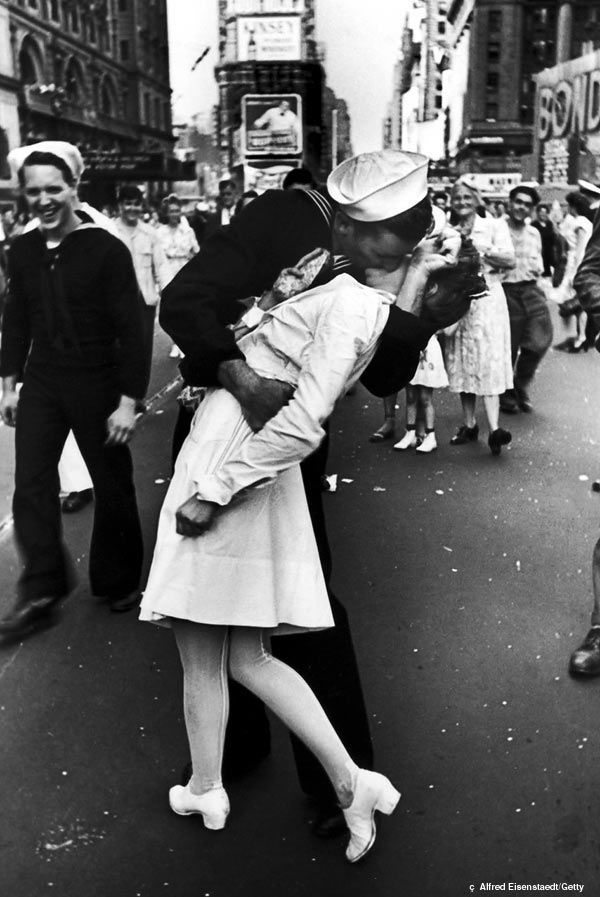
The kissing sailor, Greta Zimmer Friedman, George Mendonsa

Most of us are familiar with this picture. Captured in Times Square on V-J Day, 1945, it has become one of the most iconic photographs of American history, symbolizing the jubilation and exuberance felt throughout the country at the end of World War II.

For a long time, the identity of the pair remained a mystery. It certainly looks passionate and romantic enough, with many speculating that they were a couple – a sailor and a nurse, celebrating and sharing their joy. This year, however, historians have finally confirmed that the woman is Greta Zimmer Friedman, a dental nurse at the time, and George Mendonsa, a sailor.

Have a look at some articles about it. Do you get the feeling that something is not quite right?

Huffington Post

Daily Mail

CBS News

A few facts have come to light. Far from being a kiss between a loving couple, we learn that George and Greta were perfect strangers. We learn that George was drunk, and that Greta had no idea of his presence, until she was in his arms, with his lips on hers.

The articles even give us Greta’s own words:

“It wasn’t my choice to be kissed. The guy just came over and grabbed!”

“I did not see him approaching, and before I knew it, I was in this vice grip. [sic]”

“You don’t forget this guy grabbing you.”

“That man was very strong. I wasn’t kissing him. He was kissing me.”

It seems pretty clear, then, that what George had committed would be considered sexual assault by modern standards. Yet, in an amazing feat of willful blindness, none of the articles comment on this, even as they reproduce Greta’s words for us. Without a single acknowledgement of the problematic nature of the photo that her comments reveal, they continue to talk about the picture in a whimsical, reverent manner, “still mesmerized by his timeless kiss.” George’s actions are romanticized and glorified; it is almost as if Greta had never spoken.

In a way, I understand this. The end of war is a big deal, and the euphoria felt throughout the nation on that day is an important part of American history. For so long, this photograph has come to represent that unbridled elation, capturing the hearts of war veterans and their families alike. The fact that this much-loved photo is a depiction of sexual assault, rather than passion, is an uncomfortable truth, and to call it out as such might make one seem to be a priggish wet blanket. After all, this sailor has risked his life for his country. Surely his relief and excitement at the end of the war is justified? Surely these are unique circumstances? The answer to the first question is yes. He is perfectly entitled to be ecstatic. He is perfectly entitled to celebrate. However, this entitlement does not extend to his impinging on someone else’s bodily autonomy.

The unwillingness to recognize a problem here is not surprising, considering the rape culture in which we live. It is not easy to assert that a woman’s body is always her own, not to be used at the whim of any man without her consent. It is far easier to turn a blind eye to the feelings of women, to claim that they should empathise with the man, that they should be good sports and just go along with it. And the stronger the power structures behind the man, the more difficult it becomes to act otherwise. But if we are serious about bringing down rape culture and reducing the widespread violence against women, then we need to make it clear that engaging with someone sexually without consent is not ok, even when it is an uncomfortable position to take. Especially when it is an uncomfortable position to take.

——————————-

Update: Before you comment, it might be useful to read The Kissing Sailor Part 2: Debunking Misconceptions.

*Edited on 8/10 for clarity

Slutwalk London 2012

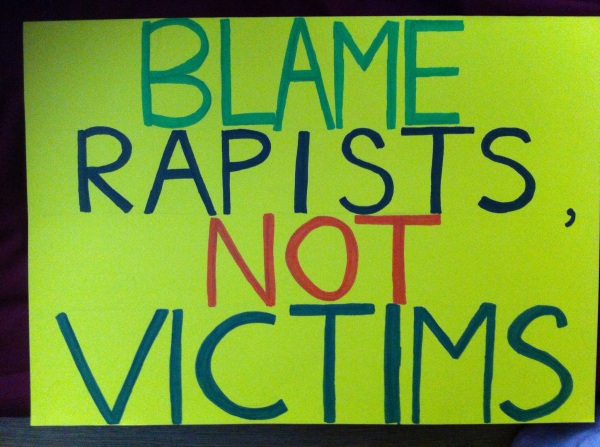
Slutwalk Sign Blame Rapists, Not Victims

My placard for the day

On 24 January 2011, a Toronto police officer gave a talk on crime prevention. When speaking about rape, he uttered the now infamous words, “Women should avoid dressing like sluts.” Enraged at his words and the culture of victim-blaming it reflected, Canadians marched to let everyone know that women’s clothes were not responsible for rape; rapists were. Although it was a Canadian police officer who had made those comments, the rape culture that gave rise to the sentiment was not confined to Canada. Women from around the world recognised it, shared their outrage, and have joined in the movement, with Slutwalk protest rallies popping up in more than 40 countries so far.

From the start, Slutwalk has been controversial, even among feminists. Some seek to reclaim the word ‘slut’, to redefine it to mean a sexually liberated woman, instead of a judgmental term used to cast aspersions on the morality of the woman to whom it is addressed. Still some wish to use the word to include all women, to demolish the idea that some women are more valuable than others based solely on a patriarchal notion of feminine purity. I’ve heard it said that “if we’re all sluts, then the term can no longer be used to divide us.”

However, many feminists, myself included, find the reclamation of the word ‘slut’ to be deeply problematic. We could insist on its redefinition, refuse to see it as an insult, but I don’t think it is possible to wipe the slate completely clean. Regardless of what we might say, sexist people will continue to use the word as an insult, and even when not intended to be used as such, historical connotations will hang off it, baggage reminding us of and reinforcing our oppression. Personally, I think the word ‘slut’ should be wiped from our vocabulary, ideally together with the words ‘virgin’ and ‘prude’. Although they are occasionally used to refer to men, it is common knowledge that women are overwhelmingly the targets of such terms. The very existence of these words places undue importance on a woman’s sexual activity, so much so that it is bound up in her identity. There is no word no describe a person who has yet to learn to drive, no word to describe someone who has never been swimming. Why are we not content with people being able to say, “I’ve never had sex before,” or “I enjoy sex and engage in it frequently?” Why do we see the need to encapsulate their sexual experience (or lack of it) in a label? When applied to women, these identity tags become even more damaging, cementing the idea that women exist as vessels for the sexual pleasure of men, and thus can be viewed as ‘used’ or ‘unused’.

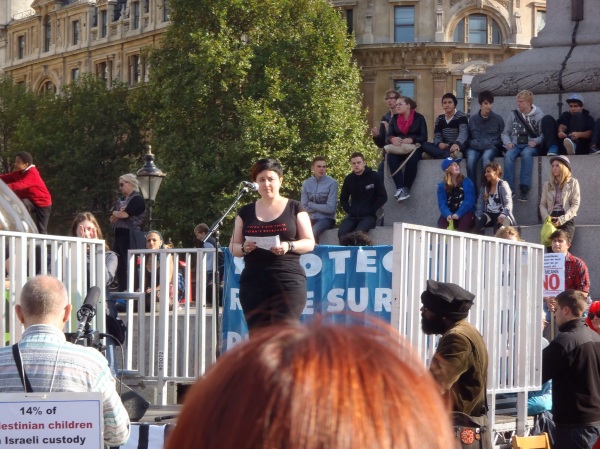
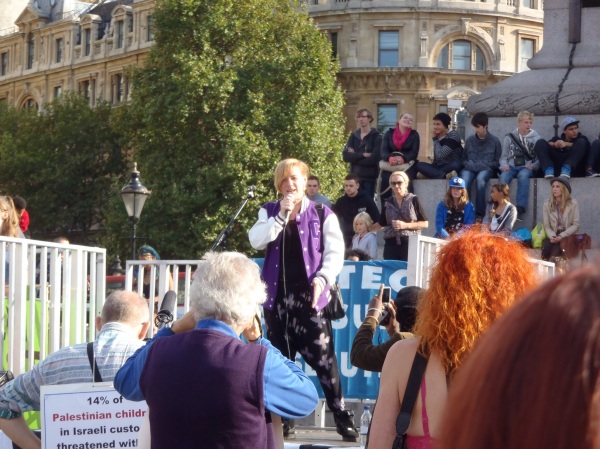
For all that, I decided to attend Slutwalk London yesterday, because Slutwalk is about so much more than the word ‘slut’. While even within the march itself, opinion was divided as to whether we should call ourselves ‘sluts’, there was one thing that everyone could agree on, and that was the notion that the only one responsible for rape was the rapist.

I had never been to a Slutwalk before, and was very moved by the experience. There was a huge turnout, of women as well as a good number of men, bearing placards denouncing the culture of victim-blaming. Here are a few snapshots:

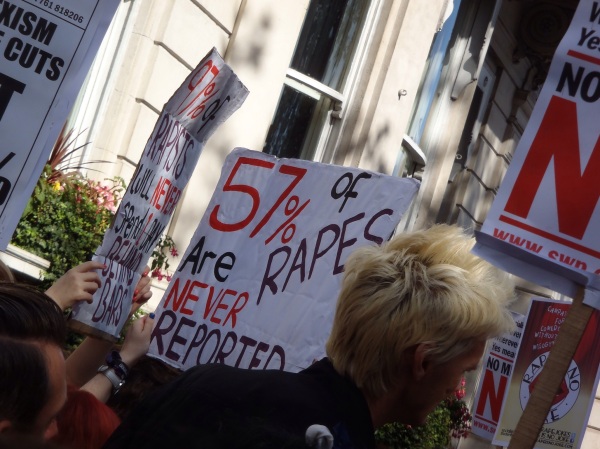
Slutwalk sign "57% of rapes are never reported", "97% of rapists will never spend 1 day behind bars"

“57% of rapes are never reported”, “97% of rapists will never spend 1 day behind bars”

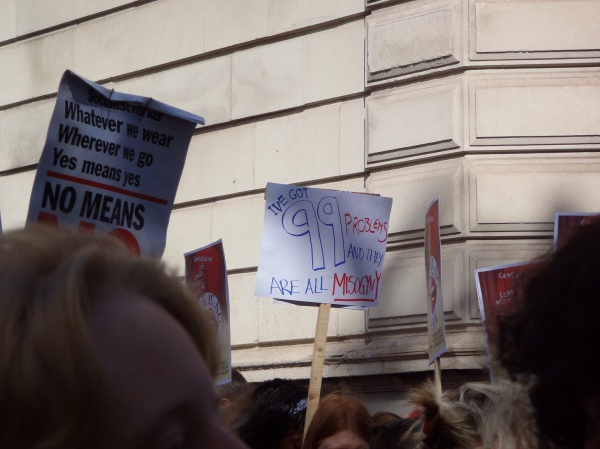
Slutwalk sign "I've got 99 problems and they are all misogyny"

“I’ve got 99 problems and they are all misogyny”

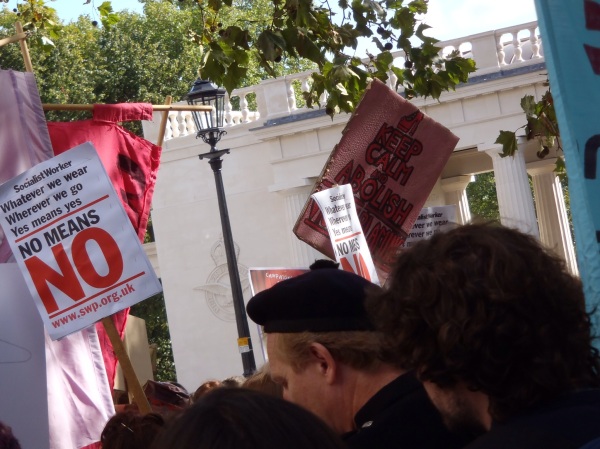
Slutwalk sign "Whatever we wear / Wherever we go / Yes means yes / No means no" , "Keep calm and abolish victim-blaming"

“Whatever we wear / Wherever we go / Yes means yes / No means no” , “Keep calm and abolish victim-blaming”

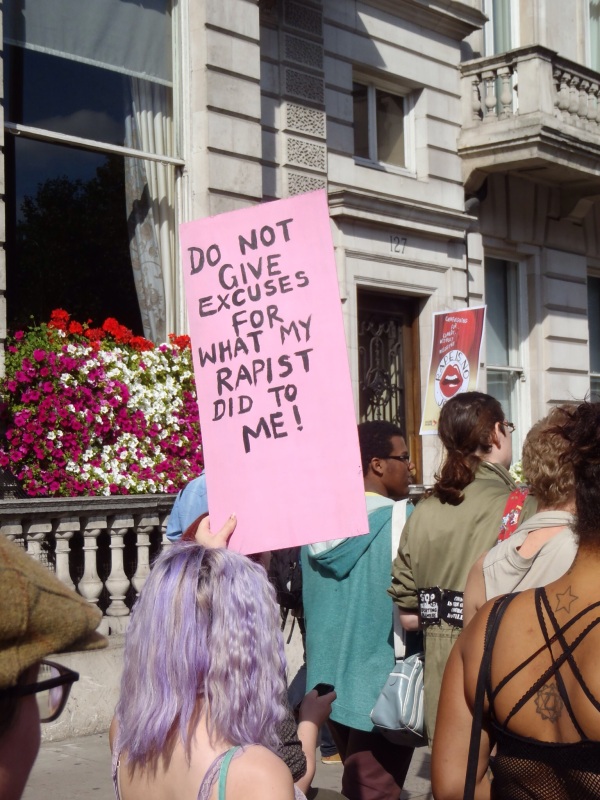
Slutwalk sign "Do not give excuses for what my rapist did to me!"

“Do not give excuses for what my rapist did to me!”

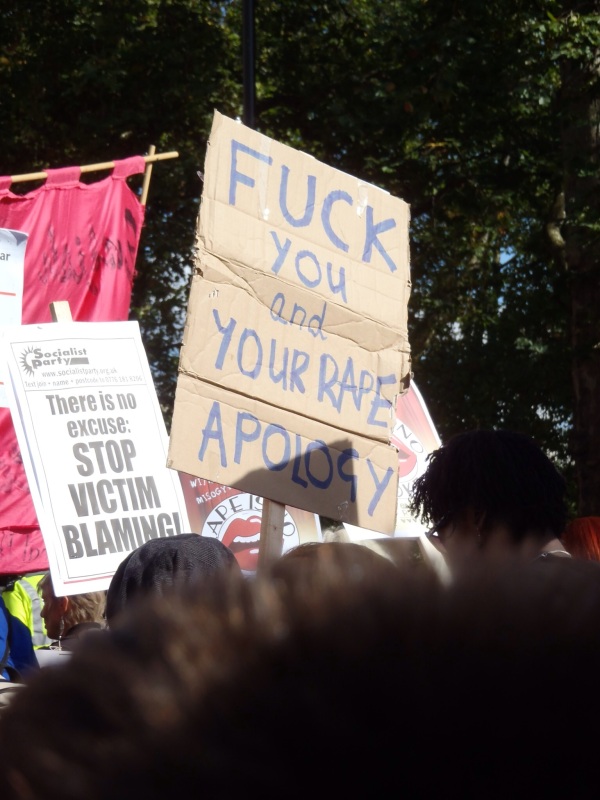
Slutwalk sign "Fuck you and your rape apology" , "There is no excuse: stop victim blaming!"

“Fuck you and your rape apology” , “There is no excuse: stop victim blaming!”

Slutwalk sign "Things that cause rape: (1) Rapists (2) See above"

“Things that cause rape: (1) Rapists (2) See above”

As we marched, we chanted refrains such as, “Whatever we wear, wherever we go; yes means yes and no means no”; “We’ve said it once and we’ll say it again, no excuse for violent men”; “Two four six eight; stop the violence, stop the rape”, among others. We called to end the shaming of women, to assert that women who wear revealing clothing are not ‘sluts who are asking for it’, and that women who do not wear revealing clothing are not ‘uptight prudes who need a good seeing to.’ We called for the right to dress and have sex on our own terms, not the patriarchy’s. We called for rape cases to be taken seriously by the police and for the public to stop being rape apologists. And at the end of our march, many brave women, most of whom were survivors, shared their stories with us.

Slutwalk London 2012 speech Emily Rose

Slutwalk London 2012 speech "Don't Chat to me" - a poem about street harassment

“Don’t Chat to me” – a poem about street harassment

Diversity and inclusivity was the order of the day. We heard the story of young women who had struggled with the justice system after being raped; the story of a mother whose daughter had been raped at the age of 16, and whose rapist had got away with it; the story of a trans woman battling with the constant discrimination and threat of sexual violence; stories about women with disabilities being denied their rights; stories about how sex workers face prosecution from the police instead of protection; the story of a gay man who had been raped, and dismissed by the homophobic police officer he reported it to. Two excellent poets also recited their work, injecting an upbeat note into the atmosphere. For me, the most harrowing but moving account came from a woman from the Caribbean, who had immigrated to the UK. She spoke about how she and her daughter had been raped and beaten up by a group of men, who forced her to smuggle drugs into the UK. If she did not do so, they warned, they would kill both her and her children. With no choice, she complied, only to be arrested in the UK and sent to prison for 9 years. She was subject to rape again in the UK, reported it, and faced discrimination and racial abuse, with her immigrant status used against her. In the end, her rapist got off scot-free. Despite all this, her strength and courage were astounding. To this day, she continues to fight against rape and for justice for rape survivors, and proclaims, “No matter what they do to me, I will not give up! I will keep fighting.”

Ultimately, this diversity made Slutwalk London a big success. It drove home the message that, when it comes to sexual violence, we are all in this together, regardless of class, immigration status, race, sexuality, being able or disabled, cis or trans. We may not all agree as to what should best be done with the word ‘slut’, but we are united in the notion that we must not allow it to be a word that is used to divide us, with ‘respectable’ women at one end and ‘loose’ women on the other. Because our sexual activity, or lack of it, is irrelevant. And no woman deserves to be raped.

Petition to Dominic Mohan: Take the Bare Boobs Out of The Sun

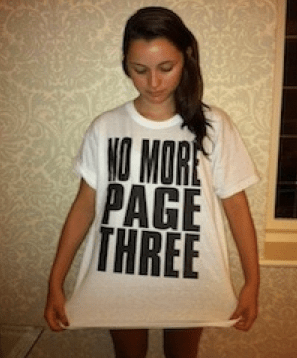
Nineteen days ago, I signed Lucy-Anne Holmes’ petition, calling for The Sun to end the practice of including topless women in their newspaper. I don’t remember the exact number of signatures it had collected at that point, but I believe it was in the hundreds. Just over 500 perhaps, certainly fewer than a thousand.

Since then, the petition has seriously gained momentum. Featured in The Guardian at least three times, as well as in foreign newspapers, the tally has hit 21 303 supporters at time of writing, and is shooting up rapidly. In fact, the last 10 000 signatures were collected in the last three days alone, and as @NoMorePage3’s twitter feed proclaims, “This is only the beginning.”

The first topless Page Three model appeared in The Sun on 17 November 1970. SInce then, it has become a tradition, with newspapers in other countries embracing the concept too. Today, according to the National Readership Survey, The Sun enjoys the largest readership in the UK, with an overall average readership of 17.8 million a month, across both print and online mediums. Given its wide circulation, as well as its marketing itself as a family newspaper, The Sun’s participation in the routine exploitation of women’s bodies is despicable, and highly irresponsible.

Perhaps The Sun needs to be reminded of what a newspaper’s purpose is. It is to inform the public of significant events, both locally and around the world, to provide insightful commentary on society, and to be a platform for intellectual discussion. A large picture of a topless woman has no place in it. It is bad enough as a standalone picture, but when taken together with the rest of the paper, it becomes far more problematic.

You see, looking through the articles that The Sun has to offer, one finds that the representation of women is very narrow indeed. Women appear as victims (“2 Female Cops Shot Dead”), mothers (“Amber Rose flashes her baby bump”), sexual objects (“Selma Blair’s baby bares her boob in public”, “Birthday Girl Catherine is Too Darn Hot”, “Pixie Lott Flashes a Load of Leg (and a bit of bra) at LFW”) or wives/girlfriends (“Liberty Ross Finds New Man After Hubby’s Fling With Kristen Stewart”). These representations culminate with the biggest female offering in the paper – a naked pair of breasts on page three, and speaks volumes about how women, and their role in society, are viewed by editors and readers of The Sun.

This is not the first time that their casual objectification of women has come under fire. In the mid-80s, Labour MP Clare Short campaigned against it, and renewed her bid in 2004. In response, The Sun unleashed a barrage of vitriol against her, calling her ‘fat’ and ‘jealous’, and asking readers to vote on whether they’d rather see Clare Short or the back end of a bus. By choosing to attack her by criticising her looks instead of engaging with her on an intellectual level, they demonstrated how completely they had missed the point, and actually strengthened Clare’s argument by proving that the objectification of women goes hand in hand with the idea that a woman’s sexual attractiveness is the main thing she has to offer.

Needless to say, I am excited about the new petition and would urge everyone to sign it. Page 3 opposers have hitherto been swept aside, silenced by the raw, hulking power of the patriarchy. But I have a feeling that this time, they will no longer succeed in silencing us. And no matter what happens now, our voices have spoken. We have said that the objectification and degradation of women on a daily basis is not acceptable, and you can be sure that this message will be heard loud and clear.