Slutwalk London 2012

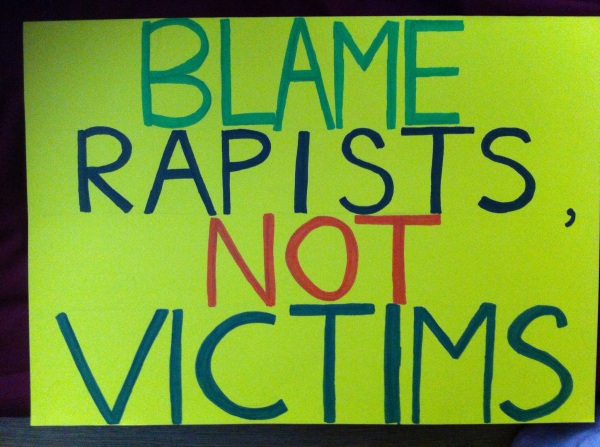
Slutwalk Sign Blame Rapists, Not Victims

My placard for the day

On 24 January 2011, a Toronto police officer gave a talk on crime prevention. When speaking about rape, he uttered the now infamous words, “Women should avoid dressing like sluts.” Enraged at his words and the culture of victim-blaming it reflected, Canadians marched to let everyone know that women’s clothes were not responsible for rape; rapists were. Although it was a Canadian police officer who had made those comments, the rape culture that gave rise to the sentiment was not confined to Canada. Women from around the world recognised it, shared their outrage, and have joined in the movement, with Slutwalk protest rallies popping up in more than 40 countries so far.

From the start, Slutwalk has been controversial, even among feminists. Some seek to reclaim the word ‘slut’, to redefine it to mean a sexually liberated woman, instead of a judgmental term used to cast aspersions on the morality of the woman to whom it is addressed. Still some wish to use the word to include all women, to demolish the idea that some women are more valuable than others based solely on a patriarchal notion of feminine purity. I’ve heard it said that “if we’re all sluts, then the term can no longer be used to divide us.”

However, many feminists, myself included, find the reclamation of the word ‘slut’ to be deeply problematic. We could insist on its redefinition, refuse to see it as an insult, but I don’t think it is possible to wipe the slate completely clean. Regardless of what we might say, sexist people will continue to use the word as an insult, and even when not intended to be used as such, historical connotations will hang off it, baggage reminding us of and reinforcing our oppression. Personally, I think the word ‘slut’ should be wiped from our vocabulary, ideally together with the words ‘virgin’ and ‘prude’. Although they are occasionally used to refer to men, it is common knowledge that women are overwhelmingly the targets of such terms. The very existence of these words places undue importance on a woman’s sexual activity, so much so that it is bound up in her identity. There is no word no describe a person who has yet to learn to drive, no word to describe someone who has never been swimming. Why are we not content with people being able to say, “I’ve never had sex before,” or “I enjoy sex and engage in it frequently?” Why do we see the need to encapsulate their sexual experience (or lack of it) in a label? When applied to women, these identity tags become even more damaging, cementing the idea that women exist as vessels for the sexual pleasure of men, and thus can be viewed as ‘used’ or ‘unused’.

For all that, I decided to attend Slutwalk London yesterday, because Slutwalk is about so much more than the word ‘slut’. While even within the march itself, opinion was divided as to whether we should call ourselves ‘sluts’, there was one thing that everyone could agree on, and that was the notion that the only one responsible for rape was the rapist.

I had never been to a Slutwalk before, and was very moved by the experience. There was a huge turnout, of women as well as a good number of men, bearing placards denouncing the culture of victim-blaming. Here are a few snapshots:
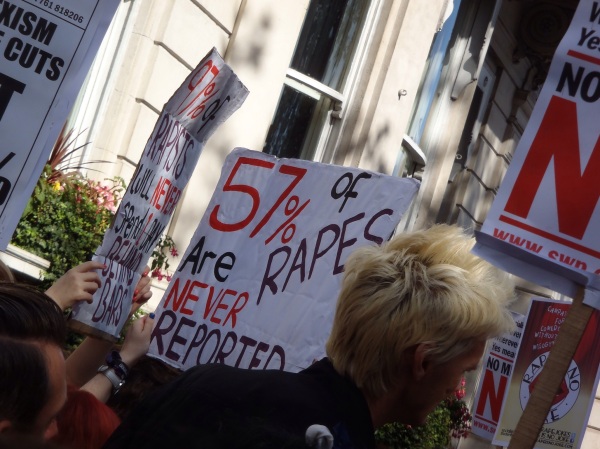
Slutwalk sign "57% of rapes are never reported", "97% of rapists will never spend 1 day behind bars"

“57% of rapes are never reported”, “97% of rapists will never spend 1 day behind bars”
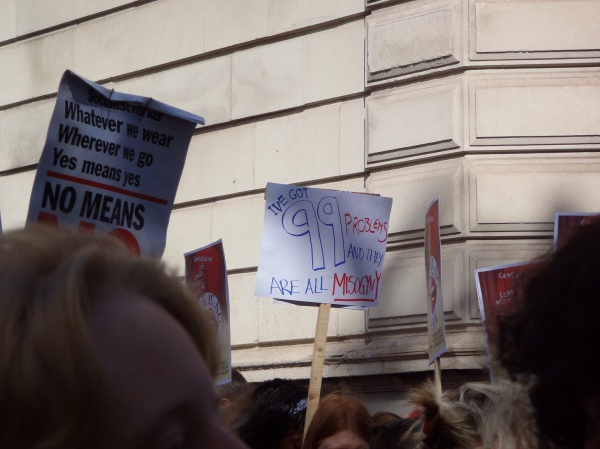
Slutwalk sign "I've got 99 problems and they are all misogyny"

“I’ve got 99 problems and they are all misogyny”
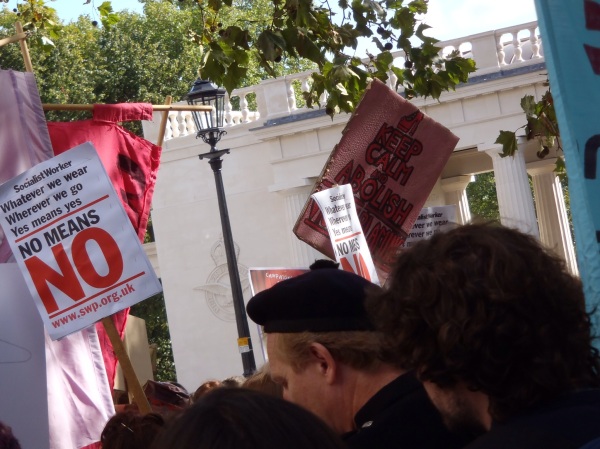
Slutwalk sign "Whatever we wear / Wherever we go / Yes means yes / No means no" , "Keep calm and abolish victim-blaming"

“Whatever we wear / Wherever we go / Yes means yes / No means no” , “Keep calm and abolish victim-blaming”
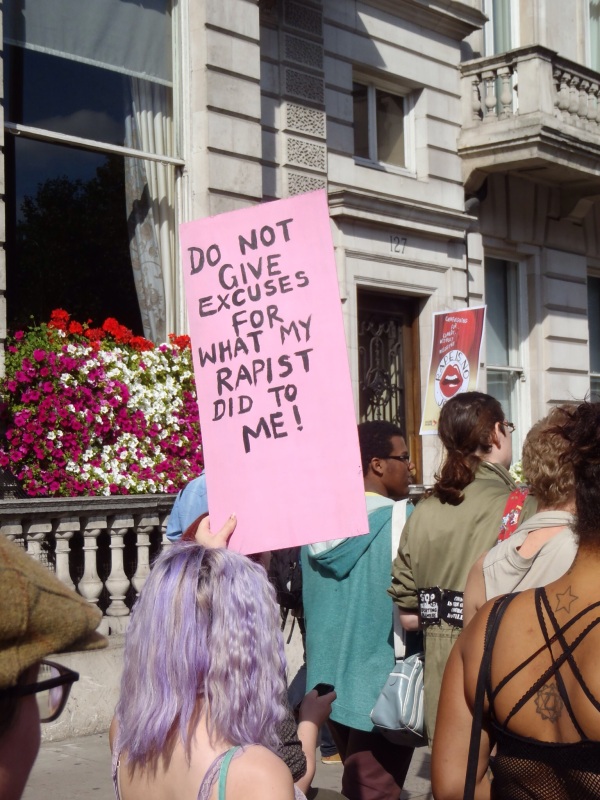
Slutwalk sign "Do not give excuses for what my rapist did to me!"

“Do not give excuses for what my rapist did to me!”
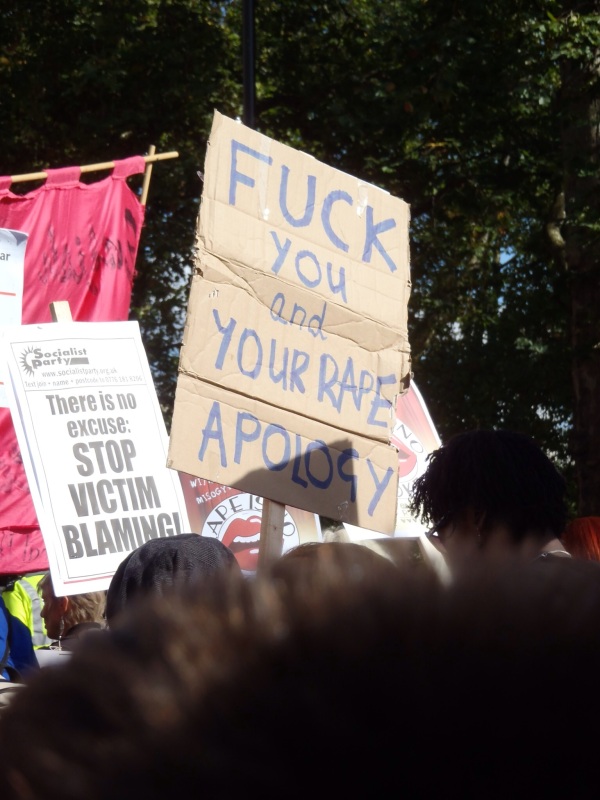
Slutwalk sign "Fuck you and your rape apology" , "There is no excuse: stop victim blaming!"

“Fuck you and your rape apology” , “There is no excuse: stop victim blaming!”

Slutwalk sign "Things that cause rape: (1) Rapists (2) See above"

“Things that cause rape: (1) Rapists (2) See above”

As we marched, we chanted refrains such as, “Whatever we wear, wherever we go; yes means yes and no means no”; “We’ve said it once and we’ll say it again, no excuse for violent men”; “Two four six eight; stop the violence, stop the rape”, among others. We called to end the shaming of women, to assert that women who wear revealing clothing are not ‘sluts who are asking for it’, and that women who do not wear revealing clothing are not ‘uptight prudes who need a good seeing to.’ We called for the right to dress and have sex on our own terms, not the patriarchy’s. We called for rape cases to be taken seriously by the police and for the public to stop being rape apologists. And at the end of our march, many brave women, most of whom were survivors, shared their stories with us.
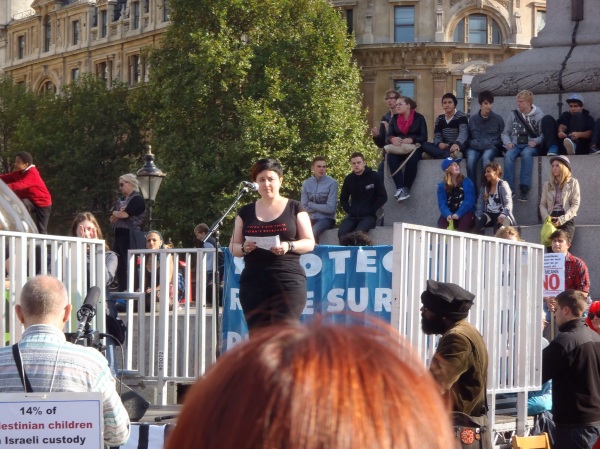
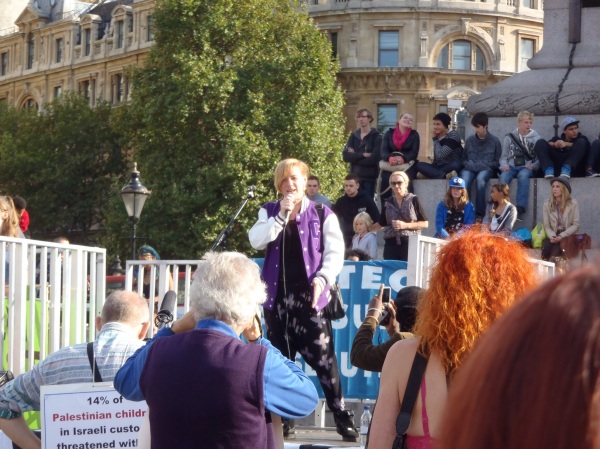
Slutwalk London 2012 speech Emily Rose

Slutwalk London 2012 speech "Don't Chat to me" - a poem about street harassment

“Don’t Chat to me” – a poem about street harassment

Diversity and inclusivity was the order of the day. We heard the story of young women who had struggled with the justice system after being raped; the story of a mother whose daughter had been raped at the age of 16, and whose rapist had got away with it; the story of a trans woman battling with the constant discrimination and threat of sexual violence; stories about women with disabilities being denied their rights; stories about how sex workers face prosecution from the police instead of protection; the story of a gay man who had been raped, and dismissed by the homophobic police officer he reported it to. Two excellent poets also recited their work, injecting an upbeat note into the atmosphere. For me, the most harrowing but moving account came from a woman from the Caribbean, who had immigrated to the UK. She spoke about how she and her daughter had been raped and beaten up by a group of men, who forced her to smuggle drugs into the UK. If she did not do so, they warned, they would kill both her and her children. With no choice, she complied, only to be arrested in the UK and sent to prison for 9 years. She was subject to rape again in the UK, reported it, and faced discrimination and racial abuse, with her immigrant status used against her. In the end, her rapist got off scot-free. Despite all this, her strength and courage were astounding. To this day, she continues to fight against rape and for justice for rape survivors, and proclaims, “No matter what they do to me, I will not give up! I will keep fighting.”

Ultimately, this diversity made Slutwalk London a big success. It drove home the message that, when it comes to sexual violence, we are all in this together, regardless of class, immigration status, race, sexuality, being able or disabled, cis or trans. We may not all agree as to what should best be done with the word ‘slut’, but we are united in the notion that we must not allow it to be a word that is used to divide us, with ‘respectable’ women at one end and ‘loose’ women on the other. Because our sexual activity, or lack of it, is irrelevant. And no woman deserves to be raped.
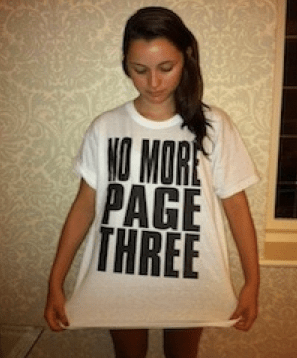
Petition to Dominic Mohan: Take the Bare Boobs Out of The Sun

Nineteen days ago, I signed Lucy-Anne Holmes’ petition, calling for The Sun to end the practice of including topless women in their newspaper. I don’t remember the exact number of signatures it had collected at that point, but I believe it was in the hundreds. Just over 500 perhaps, certainly fewer than a thousand.

Since then, the petition has seriously gained momentum. Featured in The Guardian at least three times, as well as in foreign newspapers, the tally has hit 21 303 supporters at time of writing, and is shooting up rapidly. In fact, the last 10 000 signatures were collected in the last three days alone, and as @NoMorePage3’s twitter feed proclaims, “This is only the beginning.”

The first topless Page Three model appeared in The Sun on 17 November 1970. SInce then, it has become a tradition, with newspapers in other countries embracing the concept too. Today, according to the National Readership Survey, The Sun enjoys the largest readership in the UK, with an overall average readership of 17.8 million a month, across both print and online mediums. Given its wide circulation, as well as its marketing itself as a family newspaper, The Sun’s participation in the routine exploitation of women’s bodies is despicable, and highly irresponsible.

Perhaps The Sun needs to be reminded of what a newspaper’s purpose is. It is to inform the public of significant events, both locally and around the world, to provide insightful commentary on society, and to be a platform for intellectual discussion. A large picture of a topless woman has no place in it. It is bad enough as a standalone picture, but when taken together with the rest of the paper, it becomes far more problematic.

You see, looking through the articles that The Sun has to offer, one finds that the representation of women is very narrow indeed. Women appear as victims (“2 Female Cops Shot Dead”), mothers (“Amber Rose flashes her baby bump”), sexual objects (“Selma Blair’s baby bares her boob in public”, “Birthday Girl Catherine is Too Darn Hot”, “Pixie Lott Flashes a Load of Leg (and a bit of bra) at LFW”) or wives/girlfriends (“Liberty Ross Finds New Man After Hubby’s Fling With Kristen Stewart”). These representations culminate with the biggest female offering in the paper – a naked pair of breasts on page three, and speaks volumes about how women, and their role in society, are viewed by editors and readers of The Sun.

This is not the first time that their casual objectification of women has come under fire. In the mid-80s, Labour MP Clare Short campaigned against it, and renewed her bid in 2004. In response, The Sun unleashed a barrage of vitriol against her, calling her ‘fat’ and ‘jealous’, and asking readers to vote on whether they’d rather see Clare Short or the back end of a bus. By choosing to attack her by criticising her looks instead of engaging with her on an intellectual level, they demonstrated how completely they had missed the point, and actually strengthened Clare’s argument by proving that the objectification of women goes hand in hand with the idea that a woman’s sexual attractiveness is the main thing she has to offer.

Needless to say, I am excited about the new petition and would urge everyone to sign it. Page 3 opposers have hitherto been swept aside, silenced by the raw, hulking power of the patriarchy. But I have a feeling that this time, they will no longer succeed in silencing us. And no matter what happens now, our voices have spoken. We have said that the objectification and degradation of women on a daily basis is not acceptable, and you can be sure that this message will be heard loud and clear.

BPAS Debate – Freedom of Speech, Anti-Abortion Protestors and Women: Rights and Limits

Last night, I attended a public debate hosted by the British Pregnancy Advisory Service, on the rights of anti-abortion protestors to campaign outside abortion clinics. The pro-choice half of the panel consisted of Ann Furedi, chief executive of BPAS, and Sarah Ditum, a writer and journalist. The opposing half consisted of Andrea Minichiello Williams, founder of Christian Concern, and Max Wind-Cowie, a writer with centre-right political beliefs.

Both Ann and Sarah gave excellent speeches. While fully supporting the notion of freedom of speech as essential to the exchange of ideas, they argued that freedom of speech does not extend to the right to bully, harass, and intimidate. As Ann asserts, “It is not a kind of charter that allows you to say anything you want, to anyone you want, at any time you want, in any place you want.” And you can be sure that when anti-abortion protestors camp outside a clinic, they are not attempting to engage in debate or change public opinion; their sole purpose of being there is to shame women into keeping the unwanted pregnancy. Not only do they thrust leaflets at the women and wave disturbing images in their faces, some even go so far as to pursue them, or bar their entrance into the clinic. Clearly, this sort of behaviour is absolutely unacceptable.

Representing the anti-choice league, Andrea gave a number of predictable arguments. Although the chair, David Allen Green, had explicitly told us that the aim of the debate was to discuss the juggling of the right to free speech with the right of women to be safe from harassment, and not to discuss the morality of abortion, Andrea spent much of her time trying to convince us that abortion was wrong. She also decided to exercise her own freedom of speech by showing Abort67’s graphic video during her original presentation. Instead of engaging with the debate, she chose the route of emotional manipulation.

Nonetheless, she did offer a few cognitive points, although most of them were slightly baffling. For instance, one of her arguments against abortion was that “the generational line would be interrupted.” To back up this notion, she proceeded to give an example of one of her friends, who had almost been aborted, but had been adopted instead. Now, Andrea told us, she has 6 children of her own. Had she been aborted, “the generational line would have been interrupted.” Is Andrea arguing against abortion here, or the state of childlessness? And is one’s generational line really that important? My aunt has chosen to remain single, with no children. She is approaching sixty, so I suppose her generational line has been interrupted. I’m sure she would be amused to hear that she has committed a grievous wrong.

She also used the classic Beethoven argument. Relating a story of a woman who decided not to go through with abortion, she told us about the child that was born as a result. Nigeria is now 17 years old and a cheerleader, said Andrea. If she had been aborted, she would not now exist.

I suppose there’s no denying the truth of that. Likewise, if my parents had chosen to stop at one child, I would not exist today. If they had chosen not to have sex on that particular night (or day, I honestly don’t know), I would not exist today. If they had decided to have three children instead of stopping at two, I would have a little sibling who today does not exist. And so the Beethoven argument, sentimental as it may sound, really does not hold.

But what was most astounding to me was the glaring lack of research on Andrea’s part. Not only did she assert that BPAS did not offer ultrasounds to their patients (they do), she also told us not to forget that BPAS was a business and that it was in their interests to persuade women to have an abortion. Now I am not a major player in the pro-choice/anti-choice debate, but even so, a quick glance at BPAS’ website tells me that they are a registered charity. Their twitter description explicitly announces that they are not-for-profit. Surely, this is a basic level of research that one should have under one’s belt when participating in a debate of this magnitude.

Max’s points were much less jarring. He stressed the importance of free speech, and while he would not condone assault or physical interference with patients, he felt that freedom of speech should be applicable everywhere, and we shouldn’t cordon off “certain stretches of road” (in this case the area outside an abortion clinic) as places where certain things could not be said, and certain images could not be shown. However, two of his arguments did not sit well with me.

Firstly, he mentioned that as a gay man, he was perfectly happy for Christians to come up to him and tell him why they thought his actions immoral. That, he felt, was their right. However, as my boyfriend later pointed out, it’s one thing for Max to discuss the morality of homosexuality over coffee, and quite another to have a group of people accosting him whenever he was about to enter a gay bar, or protesting outside his bedroom door. Let’s skip into the future, where gay marriage is legal and it’s a couple’s happy day. Imagine a group of anti-gay-marriage folks standing outside the wedding venue, waving banners and saying prayers, trying to persuade the couple not to enter and not to go through with it. “This is the last point where we can stop gay marriage from happening!” they cry. “We have every right to be here to save you from your sins!” Still happy with that, Max?

Secondly, Max supports the presence of protesters outside clinics, claiming that he believes women capable of ignoring them if they choose, in the same way that they can ignore a pro-life popup ad on the Internet. But these two scenarios are completely different. On the Internet, you are anonymous. The ad is present, but it’s not attempting to interact with you individually, nor does it invade your personal space. Ignoring it is much simpler than ignoring a protestor waving a banner in your face as you’re entering a clinic, sometimes taking pictures of you, calling you a murderer. And what I find disturbing is the appropriation of feminist ideas to counter feminist goals, when people say that they don’t believe women are so weak as to be unable to handle *insert manifestation of inequality here*. It’s essentially saying, ‘You’re a feminist, you believe that women are strong, right? Well then, if they’re so strong, they should be able to take it.” But feminists have never said that women have superhuman strength. On the contrary, we have insisted time and time again that women are no more and no less than human beings, with human strengths, but also human weaknesses. A woman who finds herself with an unwanted pregnancy, and is facing circumstances that make it unthinkable for her to have the child, is already in a vulnerable position. To hound her outside the abortion clinic with disturbing pictures is both cruel and harmful. Women are strong. But we are also people. We are not rocks.

In the end, the most stirring comment of the evening came from the floor. Cheryl Jones, a barrister, had the following to say:

“Those of you who are anti-abortion, perhaps try turning your attention to stopping the pregnancy in the first place, not to approaching women who are in difficult situations. They go on the Internet, they’ve talked to their friends. They’re not stupid. They know exactly what they’re doing, they know exactly what is involved. They don’t need to see those graphic photographs; they’ve already got them in their heads. Because they know what they’re doing. Stop the pregnancy in the first place: free contraception, extensive contraception, proper sex education. No more shaming of women for having sex! Because that is what is behind most of those pregnancies.” (At which point the crowd burst into raucous applause.)

And I think it is here that ‘pro-lifers’ show their true colours. Because the people campaigning against abortion are also very often the same people who are against contraception. They are often the same people who advocate abstinence, who slut-shame, resulting in a sad lack of proper sex education for many young women. If anti-abortionists are genuinely concerned about abortion numbers, they would take Cheryl Jones’ advice. They would listen to Ann Furedi when she tells them that their methods are ineffective –  the number of abortions in clinics with a strong protestor presence is no different from clinics where women are not hassled. The only difference is a higher gestation period, suggesting that the women are turned away by the protestors, only to change their minds and return. All the protestors have achieved is the prolongation of a woman’s emotional distress.

But in spite of all this, I suspect that anti-abortionists will continue to protest outside abortion clinics. I suspect that they will continue to promote abstinence and speak of the evils of birth control. Because they aren’t really pro-life, they are simply anti-choice.

Ted, and the Fallacy of ‘Harmless Jokes’

No spoilers

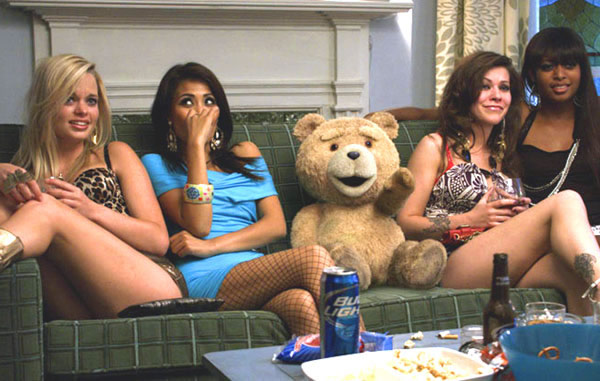
I wanted to like Ted. Although I had problems with both Family Guy and American Dad, the story arcs of Stewie/Brian and Roger were often funny, and didn’t always rely on offensive material. Being a talking teddy bear, I thought Ted would fit into the same mould.

Sadly, much of Ted’s humour stemmed from his being one of the most obnoxious non-villain characters I’ve seen on screen. He is the ultimate lad’s lad – doing drugs, sexually harassing women, surrounding himself with prostitutes, spewing racist tripe, and being quick to point out that he is totally not gay. All of which, of course, is supposed to be hilarious.

Film critic Jonathan Kim says in the Huffington Post, “It’s a film filled with the kind of jokes you might make with your closest friends, where you can say the most offensive things you want to get a laugh since your friends know you and your intent well enough not to take anything you say to heart.” Well, I’m not sure what kind of friends Jonathan has, but my friends and I certainly don’t find such things funny. No, not even in private. Not even if we ‘know we don’t really mean it.’

The whole idea of how it’s fine to make jokes at the expense of minority groups, because everyone knows you’re not really sexist, or racist, or homophobic, is a common fallacy.

In Quirkology, Professor Richard Wiseman’s book on psychology, he investigates the world of laughter by conducting a wide-ranging experiment as to the kind of jokes people find funny. He found that “the top jokes had one thing in common – they create a sense of superiority in the reader…in each case it is about one group of people trying to make themselves feel good at the expense of another.” He also goes on to say:

“Some research suggests that jokes like these can have surprisingly serious consequences. In 1977, psychologist Gregory Maio from Cardiff University of Wales and his colleagues looked at the effect that reading superiority jokes had on people’s perception of those who were the butt of the jokes. The study was carried out in Canada, and so centered around the group who was frequently portrayed as stupid by Canadians, namely Newfoundlanders (or ‘Newfies’). Before the experiment, participants were randomly assigned to one of two groups. The people in each group were asked to read one of two sets of jokes into a tape recorder, supposedly to help determine the qualities that make a voice sound funny or unfunny. Those in one group read jokes that did not involve laughing at Newfies (such as Seinfeld material), whilst the other read Newfie put-down humour. Afterwards, everyone was asked to indicate their thoughts about the personality traits of Newfoundlanders. Those who had just read out the Newfie jokes rated Newfoundlanders as significantly more inept, foolish, dim-witted, and slow, than those who had delivered the Seinfeld material.”

“Just as worrying, other work has revealed that superiority jokes have a surprisingly dramatic effect on how people see themselves. Professor Jens Förster, from the International University Bremen in Germany, recently tested the intelligence of eighty women of varying hair colour. Half of them were asked to read jokes in which blondes appeared stupid. Then all participants took an intelligence test. The blonde women who had read the jokes obtained significantly lower scores on the IQ test than their blonde counterparts in the control condition, suggesting that jokes have the power to affect people’s confidence and behaviour, and so actually create a world in which the stereotypes depicted in the jokes become a reality.”

So is Ted, as Jonathan Kim opines, “a breath of fresh air,” or does it merely trot out the same old tired stereotypes and brand of humour that has honestly gone completely stale? In a world where sexism, racism and homophobia are thriving – the very things MacFarlane’s jokes depend on – do we really believe that all “viewers are smart enough to know that they’re just jokes”?

Being obnoxious doesn’t make you cute or funny, Ted…even if you are a bear.

BIC Pens For Her and Other Unnecessarily Gendered Products

By now, we’ve probably all heard of the BIC Cristal pens “For Her”, as well as some of the wonderful, sarcastic comments on Amazon UK. I thought I’d share two of my favourites:

A treatise on the suitability of the pink pen

Pray, what is a ‘pen’? I do like it so, because it is so pink, but I remain ignorant as to its practical use. Father says not to ask questions because it might give me wrinkles, and to carry on practising my charming giggle so I can one day ensnare a Duke – but I cannot help but be intrigued by the delicate pinkness of this curio. I can only assume that because it is pink, it is intended for a woman’s usage. I am a woman, therefore perhaps I should have this pink so-called pen?

Does one place it delicately in the hair? Could one perhaps keep it in a box and take it out to peer at on occasion, when Father is busy in the library (wherever that is)? Is it an appropriate subject for after-dinner conversation? Might one take it on a lovely picnic in Hyde Park?

Naturally, we women are single-mindedly intrigued and captivated by the appearance and beauty of all things. It is almost as if my very womanhood calls out to objects of this colour and demands to be in possession of anything which combines the fascinating shading of red and white. If the ‘pen’ (an ugly name, I think) were not so pink, I should never have noticed it nor considered its potentialities as a purchase.

However, I am frightened and cautious as well as capricious and flighty, such as only a woman can be. Upon consultation with my conscience, I cannot in all good faith acquire such an item without being fully apprised as to its application. Now that I think upon it, I have heard mutterings about the use of ‘pens’ amongst Father’s business associates whilst pouring the tea for them (though I am sure they cannot have pink ones! An absurd notion!), and this would indicate that they are wholly inappropriate utensils for the fairer sex. I fear I have been enticed into unhealthy enquiry by the dazzling genius of the manufacturer. In colouring this object so, he has perhaps some deviant purpose in mind, correctly assuming that one such as myself may happen upon it and be naturally, helplessly seduced by the hue irresistible.

I shall not be tempted. I shall not enquire nor express any future enquiry as to the purpose of the pink pen. I must not feel it throb in my fingers, if indeed that is where it is intended to be placed. I shall endeavor henceforth to merely collect other pink objects; shells, ribbons and pretty trinkets such as might be suitable for a girl of marriageable age and limited mental capacity.

Yours &tc.”

-By “You Don’t Need My Real Name”

And:

The pen for women that lets them KNOW they are women!

Thank you so much Bic!

These are more than just pens. They are little pink saviours. Every girl and woman should own one.

All my life I have written predominantly with black, blue, clear plastic, or, occasionally, metallic coloured pens. It never felt right. My sense of womanhood was deeply impacted by the lack of gender defined stationary. I remember once, writing in a public library, a child asked the time, and referred to me as `mister’. Mortified, I reflected upon why I had been so cruelly misgendered. I mean, I’m no Marilyn Monroe but I like to make an effort! Then it came to me: I was writing with an ORDINARY pen. Nothing in this writing implement made it obvious that I was a WOMAN. The next thing you know, this child might have asked me to fix something! Or assumed I understood the ins and outs of science!

Until I found your `for her’ range of pens, I was in genderless limbo. No, make that hell. Horrified at the thought of a repeat incident, I wrote only in private. No amount of make up, pink dresses, heels, and jewellery could fill the aching sense of androgyny that now consumed me. Concerned at my obvious deep misery, and apparent pen phobia, my friends and family began asking questions. How could I tell them? How would you?

Then – I saw them. First it was the pastel colours. Good, yes, but not clearly enough defined. A closer look and my heart skipped a beat. Could it be true? Pens `for her’? I don’t want to go into detail, but I will tell you that I emitted sounds of euphoria I never thought humanly possible. Many tears were wept. Tears stained pink with feminine joy.

As you can imagine, I counted the minutes until this precious package arrived. I took the day off work, bought myself a new pink writing pad, and practically sprinted to the nearest busy café. Settled with a skinny mochachino, I pulled out my new `for her’ pen (pink of course!). The result was astounding. As I began to write, flowers, heart shapes and ponies appeared on the page. I had unleashed and connected with my inner femininity! There was no stopping me now. You won’t believe what happened next. A man, looking uncannily like Burt Reynolds (in his heyday no less!), approached me and said: `Hey babe [Babe!]. That’s a pretty pen for a pretty lady’.

Needless to say we are now engaged and living in blissful heteronormativity. Stan has even asked me to make a special request to you, Bic – `for him’ pens! He says they could be in the shape of beer bottles or golf clubs. And why stop there? (said Stan). A ruler that looks like a brick would make any man feel more of a man. He is so clever. He says you must make sure to send him royalties! How we laugh about that, every morning. (But seriously, do credit him if you take the ideas on board.)

Anyway, I am sure there are still many more stationary items to be gendered feminine, and too little time! Thank you for giving me back my sense of womanhood, and please – never underestimate your role in promoting the gendering of girls and women.

-By “Happyshopper”

———————————-

I’m delighted that so many have seen it for the bullshit that it is, and that it has gained so much publicity. But it did make me think of other products that are unnecessarily gendered, but which often pass unquestioned. Particularly products made for children.

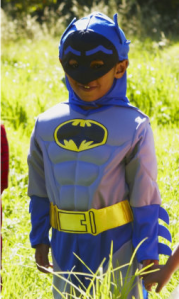
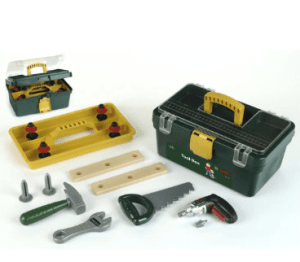
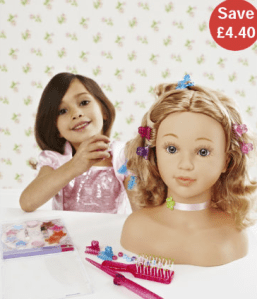
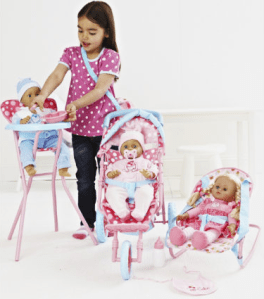
Head on over to the children’s section of any store, and you’ll immediately notice it divided: stuff ‘for boys’ and stuff ‘for girls’. You can probably guess what kind of products are considered boys’ toys or girls’ toys, but if you really need convincing, I’ve created a little sample here. These photos were taken from the Early Learning Centre, not because I’ve got anything against them in particular, but because their site was the first one I came across and I thought it was a good microcosm of the toy world.

Boys’ stuff:

Girls’ stuff:

The overwhelming message is a shockingly archaic one. Boys are active! They can be firemen, policemen, superheroes, race car drivers. They can do science and technology, and build robots for the future. Girls, on the other hand, are decorative. Their mission in life is to look beautiful and put in effort to do so. Once they have achieved this, their next task is to strike a pose, inviting admiration of their physical perfection. Their place in life is in the home – feeding babies, pushing prams, baking, and cleaning up the house. (Seriously, how is a dustpan and brush a toy?! ) If they do decide to go to work, they could enter the medical profession… but only as a nurse, not a doctor.

Children learn quickly, and adapt to the society in which they find themselves. And one of the most pervasive ideas we teach them is conforming to gender roles.

This is the definition of the word ‘role’ in the Oxford Dictionary.

noun
•    an actor’s part in a play, film
•    the function assumed or part played by a person or thing in a particular situation

This is the crucial aspect of gender roles. They aren’t a reflection of how men and women really are, they are “part[s] [that we] play”, identities that we “assume…in a particular situation,”  in this case, a patriarchal society. They are a performance that we learn to perfect from a very young age, and its roots have sunk deep into us, so much so that any deviation now feels unnatural.

Worse, children aren’t just taught about the gender divide and which side they fall on, they are also taught which gender is superior. Boys, especially, are policed strictly, and any hints of ‘feminine’ behaviour from them (including but not limited to: playing with ‘girly toys’, dancing, crying, liking pink, dressing up) are met with horror and chastisement from their parents. They learn from very early on that being called a girl is the worst thing that someone could say to them, a fate to be avoided at all costs. Is it any wonder, then, that women and girls are disrespected, that their views are seen as inherently of less value than a man’s?

Children aren’t born knowing what is expected of their gender. Boys aren’t born believing that it’s shameful to be a girl. Through the toys that we make for them and the messages that we send them, they are taught about their roles and status every day. And when they grow up, they will pass it on to their children in their turn, unless we make an effort to end this cycle and make gender roles a thing of the past.

George R. R. Martin, and the Misogyny in Game of Thrones

Don’t worry – no plot spoilers!

According to an article on Gender Focus, the Game of Thrones panel at Geek Girl Con failed to fully acknowledge the depth of misogyny in the series, settling for run-of-the-mill cop-outs instead.

The usual suspects turned up. One of them was: since A Song of Ice and Fire is part of the fantasy genre, which is based on history, the social hierarchies of the time have to be portrayed faithfully and it isn’t sexist to do so. Another was: George R. R. Martin is a decent guy, so he can’t have been sexist. He was probably just a little insensitive.

As Hodge rightly points out, the first point does not hold water. There were no skinny, icy killers called ‘The Others’ in Medieval England. Summer has never lasted eight years. No king of ours ever won his crown by riding a fire-breathing dragon into battle. So why glorify the brutalization of women? Martin was not forced to do so. Everything in the book was a choice, and he chose to mimic the extreme inequality of that era.

Of course, that’s not to say that rape or the debasement of women can never be depicted in fiction. Stieg Larsson’s Millennium trilogy was rife with scenes of rape and sexual torture of women, yet his books project a very strong feminist message.

First of all, Larsson is very clear as to his reasons for such scenes. In The Girl with the Dragon Tattoo, he begins each section with a statistic, drawing our attention to the problem of violence against women in Sweden. “18% of the women in Sweden have at one time been threatened by a man,” Part 1 informs us. “46% of the women in Sweden have been subjected to violence by a man,” says Part 2, and so on. The assaults and murders that happen in his books do not pepper the text like bits of fancy decoration; rather, they are central to the plot and development of his characters, and the reader is forced to appreciate the horror and depravity of such acts.

Sadly, in A Song of Ice and Fire, rape or abuse of women happen on almost every page. They are depicted in an offhand manner, completely gratuitous, and pass without comment. Worse, the perpetrators are frequently portrayed as sympathetic characters instead of villains. I came across a rape/assault reference almost every five minutes, and to give you an idea of just how much random rape that adds up to, each book is about 800 to over 1000 pages long. There are five books so far, with two more in the making.

Another significant difference is that Larsson’s fictional rapes occur in modern-day Sweden, and form part of a commentary on the unequal gender relations in the society to which he belonged. One of the panellists at Geek Girl Con said, “I think he [George R. R. Martin] is making a profound allegorical statement about the US in the last century.” Now I don’t buy this for a second. If Martin’s intentions were indeed to make a statement about the power relations in contemporary US culture, why on earth would he choose to set his tale in a world that obviously reflects the values of the medieval period? Far from encouraging his readers to think critically about today’s society, it smacks of a kind of moral complacency. The reader can look back at these knights and kings and think, “Wow, things were certainly grim back then. What a long way civilization has come.” Far from encouraging critical analysis of contemporary society,  it actually pulls it up short, luring the reader into self-congratulation – “We’re so much better than these barbarians!”

And that is why I cannot believe that Martin’s choices were geared towards societal reform. But that’s ok; not every work of fiction has to have a social or political agenda. There’s a place for all kinds of books, from the highly political Animal Farm to the mysteries of Agatha Christie, from the humour of Diary of a Wimpy Kid to the magical world of Harry Potter. But here’s the rub: we’ve established that A Song of Ice and Fire isn’t political. It isn’t humorous, and it doesn’t invite readers to exercise their wits. Martin’s series is in the same genre as Harry Potter is. It’s written purely for escapism and entertainment, where readers can leave the real world behind for a moment and revel in the author’s creation. But while there’s nothing too disturbing about a child (or grown-up) imagining that they can pick up a wand and do magic, there’s something very creepy about millions of people choosing to escape into a world where women are nothing more than objects to be bought and sold, where young girls are raped by the side of the road, and where the brutal killing of defenceless women is normalised.

The biggest mistake made by the panellists at Geek Girl Con was, in my opinion, an over-emphasis on George R. R. Martin himself. It appears that one of them personally knew him, and was thus keen to defend his character, assuring people that he was not a nasty piece of work. The implication is that Martin is not a bad man, ergo, his books can’t be that bad. I can’t stress enough just how flawed this line of reasoning is. I’m happy to believe that Martin is not a bad person. If he were to tell me that he’s never raped or hit a woman in his life, that he loves the women in his family and cares deeply about them, I will believe him. I do not think that he consciously intended to be sexist when writing the books. Indeed, there are a few scenes where he makes an effort to go against stereotypes, and some of his characters actually speak out about the condition of women.

What we need to understand, though, is that patriarchy is embedded into society, and has been so for a long, long time – as far back in history as you can possibly go. Individuals do not need to be villains to be sexist. Just as rapists are seldom men who pop out from behind a bush or accost you in a dark alleyway, perpetrators of everyday misogyny are not always violent men who blatantly hate women. They could be – and often are – people that you know and like. They could be your friends, boyfriends, husbands, fathers, brothers, sons, or colleagues. But that doesn’t mean they are all evil people. They are merely products of a patriarchal society who haven’t yet seen the possibility of a different way of being. They are me, before I embraced feminism. They are what I could be like, were I a man and had no reason to look too closely at society.

But until we learn to separate the individual from the misogyny that they perpetuate, and recognise that to vilify the misogyny is not to vilify the perpetrator, we will always be in danger of pussyfooting around the subject, instead of calling someone out on their sexism.


(Note: there are spoilers up to the third book in the comments)

The Problem with “Feminist Porn”

Feminism has had an interesting relationship with pornography. Second-wave feminists were unequivocally hostile towards it, with activists such as Andrea Dworkin and Catharine MacKinnon attacking the industry for its impact on women. Calling it “the graphic sexually explicit subordination of women through pictures or words,” they claimed that pornography desensitized men to the humiliation and degradation of women, leading to an increase in cases of rape and violence against them.

For all their verve, the porn industry has only got bigger and bigger; pornography becoming more and more mainstream and accepted. Women who speak out against porn are labelled as frigid prudes, while women who talk about enjoying porn with their boyfriends are given the thumbs-up from society. Many feminists seem to have given up that fight, accepting that porn is here to stay, and have settled for working within that framework rather than calling for its abolition. One of the ways that they have done this is by coming up with porn that is more feminist-friendly, where women are more natural, come in all shapes and sizes, and the videos are woman-produced and woman-owned.

Are these sites more feminist-friendly than what we think of as ‘normal’ porn? Sure. In mainstream porn, we see a host of interchangeable girls with large breasts and small waists, with men tit-fucking them, slapping their breasts, shoving their cocks in their mouths, or shooting cum in their faces. In fact, the only scenes that seem to be about mutual satisfaction are the ones where women pleasure each other in the absence of men, although of course in these instances the male gaze is assumed. By contrast, sites such as Furry Girl, VegPorn, Femmerotic and Erotic Red unashamedly celebrate the natural and oft-uncelebrated, whether its female body hair, different female body types, or menstruation. All of which are good things.

Yet, clicking through the sites, I see pictures of women, pictures of women, and more pictures of women. I’m glad that we’re being more inclusive, but I, as a straight woman, would also like to be aroused by porn. Thank god for gay porn (which, in the male-dominated porn industry, obviously means gay male porn.)

This is a massive imbalance in the porn industry, and one which we seem to have normalized and accepted, so much so that it doesn’t even occur to us. The industry continues to spew out videos and images of women – women’s faces, women’s breasts, women’s vaginas, women’s moans – the only close-ups you get of the men are of their erect penises, and most of them hardly make any noise aside from some stoic grunting. And then, when only a fraction of women are aroused by such videos, compared to hoards of men, society has the audacity to conclude that women are not aroused by visual imagery, that women have lower libidos, that women prefer romance, and so on and so forth. And the fact that women are subtly encouraged to enjoy porn that has been created exclusively for men is ludicrous, and smells like the dreaded assumption that “men are people; women are women.” A woman who likes what your stereotypical man likes is cool, be it football, guns, beer-guzzling, even sexual encounters with other women, apparently. But god forbid a man be into anything a stereotypical woman likes. God forbid he be interested in dolls, ballet, or sexual encounters with men. That above all.

The examples we have of feminist porn sadden me. Have we become so used to seeing women as sex objects to be viewed by men, that a role reversal is inconceivable? Is making the porn industry more feminist just about creating a greater diversity of women? Are men only to be objectified when the consumers are other men? (as in gay porn?) Are women only allowed to be consumers when the objects of arousal are other women?

In theory, I see nothing wrong with sexual objectification. But, and this is a huge but, where the problem starts is when it goes on to be part of that person’s identity, an assumption that that is all they are. And this is what is happening to women, not just individual women (though certainly some experience it more than others) but women as a group. Thus I have no real problem with pornography in theory, but as it stands today, rife with misogyny, coercion, humiliation, shame and degradation, it sickens me.

Certainly, the porn industry needs to be revolutionised, and I suppose the sites I’ve listed above, and others like them, are a small step in the right direction. But we need to challenge the view that only men can be consumers, to show that women can enjoy men too, rather than merely expanding the net of women who qualify to be featured as sex objects. We need to remove the shame and stigma associated with pornography, to improve the lives of the actors within it. We need to harness a genuine and equal level of respect to all – all genders, all races, all orientations, all actors, and all viewers. Only then can I get behind it, and proclaim just how feminist pornography can be.